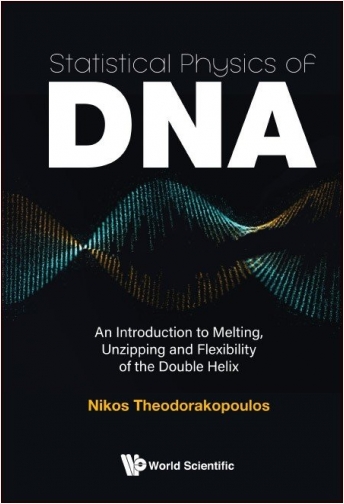
Statistical Physics Of Dna An Introduction To Melting, Unzipping And Flexibility Of The Double Helix
Editorial: World Scientific
Disponibilidad: Bajo pedido
Notas: Sin existencias Existencias: 0
Existencias:
(*)Los precios y existencias están sujetos a cambios sin previo aviso.
The stability of the DNA double helix is contingent on fine-tuning a number of physicochemical control parameters. Varying any one of them leads to separation of the two strands, in what constitutes a rare physical example of a thermodynamic phase transition in a one-dimensional system. The present book aims at providing a self-contained account of the statistical physics of cooperative processes in DNA, e.g. thermal and mechanical dissociation, force-induced melting, equilibria of hairpin-like secondary structures. In addition, the book presents some fundamental aspects of DNA elasticity, as observed in key experiments, old and new. The latter include some recently published scattering data on apparently soft, short DNA chains and their interpretation in terms of local structural defects (permanent bends, kinky DNA, after the original CrickKlug hypothesis). The development of mathematical models used (KratkyPorod polymer chain, PolandScheraga and PeyrardBishopDauxois models of DNA melting) emphasizes the use of realistic parameters and the relevance of practical numerical methods for comparing with experimental data. Accordingly, a large number of specially produced figures has been included. The presentation is at the level of an advanced undergraduate or introductory graduate course. An extra chapter provides the necessary mathematical background on elasticity of model polymer chains.
| Título | Statistical Physics Of Dna An Introduction To Melting, Unzipping And Flexibility Of The Double Helix |
|---|---|
| Autor | Nikos Theodorakopoulos |
| Editorial | World Scientific |
| Año | 2020 |
| Idioma | |
| Páginas | 196 |
| ISBN | 9789811209536 |
| Pasta | Dura |
| Disponibilidad | Bajo pedido |




Envio Gratis
Compras desde de $800
Pagos Seguros
100% Pagos Seguros
Devoluciones
30 dias devoluciones garantizadas
24/7 Asistencia
Asistencia personalizada

LA PÁGINA WEB QUE TU LIBRERÍA NECESITA